
With every two-wheeler company except Bajaj offering scooters now, that day is not far when the company that made 'Haamara Bajaj' a household name will get back to the segment where it once ruled.
The Vespa Esclusivo is the first limited edition model of the Vespa scooter in India. Only 1,000 units will be offered with every unit having a number badge to it, which gives it exclusivity!
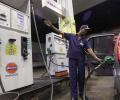
After the latest spike in crude oil prices, petrol prices could potentially go up to around Rs 90 a litre making a dent in the consumer's wallet. This, the analysts fear, will push the cost of vehicle ownership in the country, further reducing the demand potential for the industry.
After months of delays following differences Bajaj Auto, Renault and Nissan on Tuesday signed an agreement formalizing roll-out plans for 2012 - a year behind schedule.
'Investing in the stocks of holdcos can be a very efficient and inexpensive way of gaining exposure to the stocks of India's reputable growing business houses.'

As many as 140 stocks hit their respective 52-week low levels.
A slew of new products in the mid-segment line-up like Star City Plus and Victor, an agreement with global brand BMW to launch new range of bikes and a strong marketing push is what the Chennai-based automaker has up its sleeves to take on established players in the two-wheeler market.

The production at Bajaj Auto's Chakan plant near Pune remained crippled on Wednesday as the agitation by company's nearly 2,000 employees over wage revision and other demands continued for the second day.
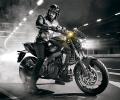
Royal Enfield sees its scale and dominant market share as adequate buffers against Bajaj's recent challenges, says Ajay Modi.
Harley Davidson, KTM-Bajaj, M&M make India production base for automobiles to be assembled and sold in China.
The quadricycle would meet better emission and safety standards than the current three-wheeler does. And, it can give a better ride, particularly during the monsoon.

Tata Motors, Mahindra & Mahindra and Bajaj Auto have noted a rise in these incidents.
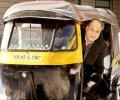
Confirming that the company could shift its production to other facilities, Bajaj Auto Managing Director Rajiv Bajaj told Business Standard: "If we take a view that this (labour issue) is going to extend over the next two months, we certainly can do that, and will do that."
Bajaj Auto has launched a new range of passenger three-wheelers, with improved mileage, changed styling and lower maintenance costs.
Opposition to the idea of quadricycles is a story of sour grapes, says Rajiv Bajaj.

On Day One of the lockdown announced by the Maharashtra Government, it wasn't business as usual for automobile manufacturing units in the State. Confusion prevailed over regulations-what is allowed and what isn't. While some units ran with less than half the workforce, others sought clarity from the government on what is permissible and what isn't.
Economists advise against it, citing international experiences; business leaders say RBI should allow move for inclusive growth.
What will you be game for? An affordable performer or a true-blue track machine?
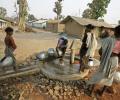
In May, Satpal Singh, who runs a dairy business with three buffaloes in Jewar, near Noida, was worried about the steep spike in input costs. Singh said dry fodder rates, which cost Rs 1,500-2000 per tractor trolley last year, were quoting at Rs 4,500-5,000. The price of other cattle feed ingredients (that include mustard meal and similar mixes) had also gone up from Rs 2,000 per quintal to Rs 3,100-3,200 per quintal.

Top gainers in the Sensex pack included Hero MotoCorp, Maruti, M&M, Bajaj Auto, HUL, HCL Tech, Bajaj Finance, ITC, HDFC and L&T, rising up to 7.51 per cent.
The TVS Phoenix 125 is a comfortable commuter motorcycle with good quality, writes Faisal Ali Khan of MotorBeam.com.
Nissan's executive vice-president and CEO Carlos Ghosn's key man for his new strategy in emerging markets, Andy Palmer, tells Business Standard how the Tata Nano's experience made his company steer away from the $2,500 car. He also speaks about how Nissan's association with Bajaj Auto to develop a small car failed, making his company place its bets on the Datsun brand to grow its market share 10-fold over the next three years.
Bajaj Auto's plant in Chakan has been shut for three days.
Amid rising petrol prices, two-wheeler makers such as Mahindra & Mahindra, TVS Motors, Hero MotoCorp and Bajaj Auto are stepping up research to develop engines run on diesel or other fuels.
The aggregate numbers suggest an improvement in the operational performance of these companies.

These companies gave annualised returns of 11% on an average in the last five years, while shareholders of family-owned companies saw 5% annualised erosion
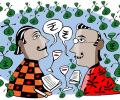
At the end of Monday's trading session, the market capitalisation of BSE-listed companies stood at Rs 1,51,86,312.05 crore against Rs 1,46,58,709.68 crore on Friday.
Rajiv Bajaj talks about his de-risking strategy, as well as his company's much-speculated relationship with Renault-Nissan
Bajaj blamed a 'few rotten eggs' for the strike.

The Qute infant of the four-wheel world is Bajaj Auto's quadricycle. The Qute infant of the four-wheel world is Bajaj Auto's quadricycle. It is finally set to hit the India roads but the challenge of creating a new category in the competitive automobile market has only just begun.
The Duke 390's pricing is introductory and KTM is likely to hike it in the next couple of months.
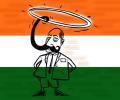
Equity investors should thank cash-rich biggies such as TCS, ITC, HUL, Nestl, and Bajaj Auto for this.
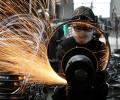
As Covid-19 cases surge in India, companies have realised it's a tightrope walk between maintaining production and ensuring employee safety.
The new Kawasaki Ninja 300 performs splendidly, it goes as fast as it looks, writes Faisal Ali Khan of MotorBeam.com.
The sight of one mobike after another from the Bajaj Auto stable as he left Srinagar airport prompted its boss Rajiv Bajaj today to ask Kashmiri students to be just not bike enthusiasts but be also involved in its production.

As macroeconomic numbers continue to disappoint, reaching pre-Covid level is unlikely in FY21.
Japanese auto maker Nissan on Tuesday said it has decided not to continue its partnership with Bajaj for sourcing of ultra-low cost car, ending months of uncertainty.
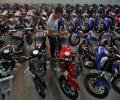
The key beneficiary of this expansion in the motorcycle market happens to be Bajaj Auto.
Also said that the slowing demand for Tata's Nano shows consumers aren't looking for low-cost cars.

Bajaj Finance was the top laggard in the Sensex pack, tanking up to 8 per cent, followed by M&M, Tata Steel, Bajaj Auto, ONGC, HDFC Bank and Kotak Bank. On the other hand, TCS, Tech Mahindra, HUL, Axis Bank and ITC were the top gainers.
